Your search keywords ship Total 1118 Article

CCS Facilitates Green Methanol Bunkering with Simultaneous Cargo Operations in Hong Kong

03/31.2026

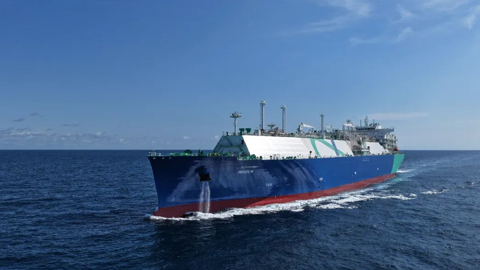
Recently, the COSCO Shipping Gemini, a vessel classed by CCS, was bunkered with 300 tons of green methanol in Hong Kong via a ship-to-ship (STS) mode, while simultaneously completing container loading and unloading operations.
See details >

China Classification Society Offshore Engineering Technology Center Issues the First Domestic AIP Certificate for LNG Pipelines

03/27.2026

Recently, China Classification Society (CCS) has achieved new progress in the development of service capabilities for new subsea pipelines.
See details >

China Classification Society was invited to attend the "2026 China Offshore New Energy Innovation and Development Forum" and delivered a keynote speech.

03/27.2026

Recently, the "2026 China Offshore New Energy Innovation and Development Forum" was successfully held in Yancheng, Jiangsu Province.
See details >

Request for ship certification(SMC/ISSC/MLC)

03/25.2026


See details >

Guidelines For Implementation Of Staturory Surveys(Ships Engaged On International Voyages, Part I)【Ver. 202512】-Consolidated edition20251231

03/23.2026


See details >

China Classification Society facilitates the delivery of the "Chongqing Emergency 012", the largest self-propelled crane ship in the upper reaches of the Yangtze River

03/19.2026

China Classification Society facilitates the smooth delivery of the "Chongqing Emergency 012", the largest self-propelled crane ship in the upper reaches of the Yangtze River
See details >

China Classification Society assists the " CM HONG KONG" in completing Hong Kong's first green methanol bunkering operation

03/19.2026

On March 5, the world's first methanol dual-fuel powered roll-on/roll-off ship, the "CM HONG KONG" successfully completed its first green methanol bunkering operation in Hong Kong.
See details >

Maritime Anti-collision Warning System for Small Ships

03/16.2026


See details >

China Classification Society and the Australian Maritime Safety Authority held a thematic exchange on new energy vessel technology

03/04.2026

Recently, China Classification Society (CCS) was invited by the Australian Maritime Safety Authority (AMSA) to attend a technical workshop for port state inspectors. During the meeting, CCS shared and exchanged specialized technical achievements on the technical characteristics of new energy vessels, safety risk management, operational management, and key points of on-site inspections, providing professional support for the safety supervision and risk prevention system construction of new energy vessels. The meeting was held in two sessions, with port state inspectors from the four major regions of Australia participating.
See details >

CLASS B SHIPBORNE AUTOMATIC IDENTIFICATION SYSTEM

03/04.2026


See details >

SHIPBORNE BEIDOU SATELLITE NAVIGATION SYSTEM RECEIVER

03/04.2026


See details >

Empowering Maritime Innovation and Safety: Mr. Pan Zhongbing Appointed as Chair of IACS Survey Panel

02/12.2026

Mr. Pan Zhongbing brings 32 years of distinguished professional expertise in ship survey and classification society operations, with profound technical acumen spanning ship and marine equipment survey, statutory compliance, quality management, flag state affairs, and maritime emergency response.
See details >

The "YuanHeKou" vessel, surveyed by China Classification Society, was named and delivered

02/03.2026

On January 26, the"Yuan He Kou", a 7,000-car LNG dual-fuel vehicle carrier, was named, delivered, and put into operation in Nansha, Guangzhou, with full technical support for plan approval , survey, and technical assistance provided by China Classification Society (CCS).
See details >

Rules For Construction and Equipment of ships carrying liquefied gases in bulk

03/30.2016

See details >

Rules for Construction and Equipment of Ships Carrying Liquefied Gases in Bulk 2026 Amendments

02/01.2026


See details >

CCS Rules and Standards Facilitating the Green, Low-Carbon, and High-Quality Development of Shipping and Shipbuilding Industries

01/21.2026

By Niu Song, CCS Shanghai Rules & Research Institute; Li Sen, CCS Offshore Engineering Technology Center
See details >

Analysis of the Current Status and Prospects of Global Onboard Carbon Capture Technolog

01/21.2026

With the advancement of the temperature control goals under the Paris Agreement, the International Maritime Organization (IMO) has formulated a phased emission reduction roadmap, targeting a 20% to 30% reduction in international shipping greenhouse gas emissions by 2030 compared to 2008 levels, a 70% to 80% reduction by 2040, and the achievement of net-zero emissions around 2050.
See details >

With the escalation of international shipping emission reduction requirements, Onboard Carbon Capture Systems (OCCS) have emerged as innovative equipment enabling deep decarbonization for traditional fuel-powered vessels.

01/21.2026

On September 27, 2025, "Shandong Xinsheng," New-build vessel in China equipped with an Onboard Carbon Capture System (OCCS), was successfully named and delivered.
See details >

Technical Service for Risk Assessment of Ships Equipped with OCCS

01/21.2026

With the escalation of international shipping emission reduction requirements, Onboard Carbon Capture Systems (OCCS) have emerged as innovative equipment enabling deep decarbonization for traditional fuel-powered vessels.
See details >

Research on Verification Methods for the Contribution of OCCS to EEDI and CII

01/21.2026

Carbon Capture, Utilization, and Storage (CCUS) refers to the process of separating CO? from industrial processes, energy utilization, or the atmosphere and achieving its emission reduction and/or obtaining side effects through engineering means.
See details >

Register of Ships

0

see details >

Sea-going Ships

0

see details >

Technical Service Product

0

The Technical Service Products involved include: Ship Business, Engineering Software and Offshore Business.
see details >

Sea-going Ships

0

see details >

Ship Field

0

see details >

Ship Survey Information

0

see details >

Application For Surveys And Issue Of Certificates Of Ship In Service

0

see details >

Application for company or ship audit

0

see details >

CCS Ship Detentions

0

see details >

Maritime Labour Convention Inspection (MLC)

0

Convention requirements:In order to protect employment, decent life and work on ships and the social rights of seafarers, the International Labor Organization (ILO) launched the Maritime Labor Convention 2006 (MLC, 2006). Ships and their maritime labor shipowners shall comply with the requirements of the MLC, 2006. According to the requirements of the Convention, ships should obtain the Declaration of Maritime Labor Compliance – Part I issued by the competent authority. Companies should also compile DMLC Part II in accordance with DMLC Part I and pass the audit of the competent authority of the flag state or its authorized accreditation body. Ships should implement DMLC Part II and obtain a Maritime Labor Certificate issued by the competent authority of the flag state or its authorized accreditation body after survey. For detailed requirements, please refer to the CCS Guidelines for the Implementation of Maritime Labor Condition Surveys.Applicable ships:The Convention is applicable to ships other than the ships that are exclusively navigating in inland rivers or sheltered waters or the adjacent waters or the areas specified by applicable ports; unless expressly stipulated otherwise, the Convention is applicable to all ships that are usually engaged in commercial activities other than the ships engaged in fishing or similar fishing activities and those manufactured by traditional methods (such as dhows and sampans), regardless of whether they are publicly owned or privately owned. And the Convention is not applicable to warships and military auxiliary ships.Applicable companies:Companies applicable to the Convention refer to the owner of the ship, or another organization or individual that has assumed responsibility for the operation of the ship from the owner and has also agreed to accept the responsibilities and duties assumed by the shipowner in accordance with the MLC, 2006, such as a manager, agent or bareboat charterer, regardless of whether any other organization or individual performed certain duties or responsibilities on behalf of the shipowner.Certificates:DMLC Part I: Companies should apply to the competent authority of the flag state for the issuance of a Declaration of Maritime Labor Compliance-Part I (DMLC Part I). CCS should apply to China MSA for the issuance of a DMLC Part I for the ship flying a Chinese national flag.DMLC Part II: Companies should compile DMLC Part II according to DMLC Part I, and submit it to the competent authority of the flag state or its authorized accreditation body for audit.Interim MLC: When a new ship is delivered, the MLC shipowner assumes the responsibility for the operation of a new ship, or changes the flag, a temporary ship survey should be conducted. After the ship passes the survey, an interim MLC with a validity period no more than 6 months will be issued.MLC: If the ship meets the requirements of the MLC, 2006 through initial survey after DMLC Part II has been implemented on board for one month, an MLC with a validity period no more than 5 years will be issued. An interim survey should be conducted during the period from the second anniversary date of the MLC to the third anniversary date, and a recertification audit conducted before the expiration of the MLC.CCS has always kept pace with the international counterparts in ship audit and certification business, obtaining authorization from the administrations of more and more countries or regions to carry out statutory surveys and issue MLC certificates on their behalf. CCS owns a team of highly educated, experienced full-time surveyors. CCS has set up branches/offices at major ports along China’s coast and the Yangtze River and in countries/regions in Asia, Europe, America, the Middle East and Australia etc., shaping up a global service network, providing our customers with convenient, timely and efficient MLC survey and certification services.To apply for ship MLC survey and DMLC Part II audit services, customers only need to submit a ship audit application form to the nearest CCS office at home and abroad.   For more details, please contact us:Tel.: 0086-21-38103599E-mail: survey@ccs.org.cn  More convenient services:EContact CCS offices/branches

see details >

Plan Approval

0

Ship’s plan approval is one of the major tasks to ensure that the ship design satisfies the requirements of the rules, conventions, regulations and the flag states. Plan approval is an important link in the ship survey chain, constituting the fountainhead of ship safety and the significant basis of field survey. After dozens of years of plan approval work, CCS regional plan approval centers have accumulated abundant experience and trained a good number of experts in the fields of ship structure analysis, stability, machinery, shafting vibration, electric, etc., and continuously improved the technical means of plan approval. In recent years, CCS carried out extensive study of key technology of plan approval and pre-contract service, having completed approval of HCSR ship type update of different types of ships. CCS plan approval centers have been maintaining a good cooperative relationship with shipping companies, shipyards and ship designers, and we will continue to serve our customers wholeheartedly in the future. CCS provides excellent plan approval level and service, focuses on mutual coordination and close cooperation with field survey of newbuildings. Meanwhile, CCS promotes in an all round way electronic plan approval, to strengthen technical guidance and software maintenance and update, ensuring the accuracy and high quality of plan approval work. ePAS makes plan approval convenient for customers due to fast plan uploading, downloading function, extensive search engine, independent and transparent client management function, detailed approval process that can be traced as well safe and effective security password function. For more details please contact the department of our head office as follows or CCS local office in your area which can be found from CCS directory. Tel:0086-21-61089200  Email:pa@ccs.org.cn  
see details >

Newbuilding Construction Survey

0

The newbuilding survey aims to ensure that the ship is constructed according to the drawings approved by the China Classification Society (CCS) and meets the class rules, international conventions and the relevant regulations of the flag state government. During the entire construction phase CCS will monitor the building process,including the materials used, ensuring that equipment and construction techniques meet CCS rules and , standards accepted by CCS.In addition, CCS will ensure that all relevant regulations of the flag state government, and the survey results are satisfactoryand meet the surveyor’s preconditions; the certified marine products are verified to meet the predetermined requirements; all the required inspections and tests are completed, and the results are satisfactory; and to guarantee that the ship construction meets the contract requirements through contract review. CCS provides clients with various survey services during the construction cycle of newbuildings on international voyages, including the survey services in the commencement, keel laying/similar construction phases, launching/undocking, sea trial and other construction phases, and the survey services for various equipment products used on board. (400,000-ton VLOC) For more details, please contact us:Tel.: 0086-21-3810-3599 E-mail: survey@ccs.org.cn
see details >

Ship Types

0

We are offering the classification services of the plan approval and newbuilding survey for multiple types of newbuildings, such as VLCC, Suezmax tanker, Aframax tanker, Panamax tanker, LR I and LR II tanker, VLOC, Capesize bulk carrier, Panamax bulk carrier, Handysize bulk carrier, Container, LNG, LPG, Chemical tanker, RORO, MPP, Heavy lift, Asphalt carrier, Dredger, Semi-submersible, Cabling boat, Pipe-laying vessel, Yacht, etc. For more details please contact the department of our head office as follows or CCS local office in your area which can be found from CCS directory. Tel:0086-10-58112452  Email:md@ccs.org.cn  
see details >

Green Ship/Energy Efficiency Service

0

Since the China Classification Society (CCS) promulgated the Rules for Green Ships in 2012, good application effects have been achieved. In early 2020, CCS updated the Rules for Green Ships (2012 Edition) and released the Rules for Green Eco-Ships (2020). The Rules for Green Eco-Ships (2020) have repositioned the green and environmental protection requirements of ships, which fully reflect the concept of ecology first and green development and are more in line with the needs of the market and the times. Based on the original requirements for energy efficiency, environmental protection and working environment, according to the development trend of green technology, a comprehensive index system for eco-ships has been established for the first time. With environmental protection as the core content, the Rules give the technical requirements and index requirements for six aspects covering the control of greenhouse gas (GHG) emissions, prevention of alien biological transfer, environmental friendliness, control of water pollution emissions, control of air pollution emissions and control of hazardous material use, which fully reflect the requirements of safety, environmental protection and sustainable development.For more details, please contact us:Tel: 0086-10-58112871 E-mail: ti@ccs.org.cn
see details >

Ship Information

0

see details >

Type Approval of Green Ships (EEDI)

0

The Energy Efficiency Design Index (EEDI) of a ship is an estimate of CO2 emissions per unit of traffic volume (freight volume) during the design stage of the ship. EEDI is a design index that considers the main factors and possible improvement methods of CO2 emissions generated by the ship inworking conditions, and encourages ship designers, shipyards, and equipment manufacturers to take measures to improve the energy efficiency of the ship and promote technological progress and innovation. It has nothing to do with the operation situation of the ship. The use of the energy efficiency design index is to consider increasing the traffic volume of the ship and taking various measures to reduce CO2 emissions during the design stage of the ship.China Classification Society (CCS) officially released the Rules for Green Ships on July 10, 2012, which are the world’s first rules for green ships for energy conservation, environmental protection and working environment. In 2020, CCS upgraded the original Rules, combined with the new connotation of green and ecological development in the new era, and formulated the Rules for Green Eco-Ships (2020) which incorporate new concepts of ecological development, promoting the upgrading of new green technical standards, and guiding sustainable, high-quality development of shipping.According to the requirements of the Rules for Green Ships and relevant guidelines, CCS provides the following services:●   Green ship type approval/evaluation services: CCS provides green ship type approval/evaluation services to assist domestic shipyards and designers to develop ship types in accordance with the requirements of the Rules for Green Ships, or to upgrade the existing design of domestic shipyards and designers to improve the competitiveness of the industrial community. ●   Green ship classification service: All ships that meet the requirements of the CCS rules for classification and have good environmental protection and energy efficiency performance are granted the green ship I/II/III class notation as a whole, or a separate class notation is granted to one of these items. This will help shipbuilders to obtain more orders, shipowners to meet the relevant requirements of maritime regulations and port states, and charterers to better understand the environmental protection performance of ships and will also guide the industry to develop new green and environmentally-friendly ship types and adopt efficient green new technologies. For more details, please contact us:Tel: 0086-10-58112160Fax: 0086-10-58112873 E-mail: ti@ccs.org.cn
see details >

Class Maintenance Survey

0

The class maintenance survey services for ships on international voyages refer to various classification survey services which CCS-classed ships should be subject to in accordance with the requirements of classification rules, in order to maintain the validity of the certificate. These surveys mainly include special survey, intermediate survey, annual survey, docking survey, propeller shaft survey and stern tube shaft survey, boiler survey, continuous survey, occasional survey, alteration or conversion survey, etc. In the meantime, ships are subject to various statutory surveys according to applicable conventions and the flag state regulations. The ship owners/ship management companies can apply to the survey unit in the jurisdiction where the ship surveyed locates, the unit where the customer manager of the shipping company works or the headquarters, by telephone, fax, email, or online. The specific survey content can be filled out in the “Application for Surveys of Ships in Service” or the online application form, or you can consult the inspector to assist the ship owner/management company to confirm the survey content. For more details, please contact us:Tel.: 0086-21-38103599E-mail: survey@ccs.org.cn  More convenient services:EOnline application for survey EContact CCS offices/branches
see details >

International Ship Security System Certification (ISPS)

0

Convention and Code requirements:In order to promote the formulation and implementation of security measures for ships on international voyages, Chapter XI-2 of the SOLAS Convention requires that applicable ships should meet the requirements of the International Ship and Port Facility Security Code (ISPS Code). Each ship applicable to the ISPS Code should carry on board a Ship Security Plan approved by the competent authority or its authorized security accreditation body, and the ship should also obtain the International Ship Security Certificate issued by the competent authority or its authorized security accreditation body after audit. For detailed requirements, please refer to the CCS Rules for Certification of Ship Security System.Applicable ships:Ships applicable to the Code include passenger ships (including high-speed passenger ships), cargo ships of 500 gross tonnage and above (including high-speed cargo ships) and mobile offshore drilling units. Those not applicable to the Code are the warships, naval auxiliary vessels, or other ships, owned or operated by the governments of the contracting states, which are used only for government non-commercial services.Applicable companies:Companies applicable to the Code refer to the owner of the ship or any other organization or individual, such as a manager or a bareboat charterer, who has accepted the responsibility for the operation of the ship from the owner and agreed to assume all the obligations and responsibilities stipulated in the International Safety Management Code.Approval of Ship Security Plan (SSP):The company should formulate a ship security plan (SSP) based on the ship security assessment report, and after passing the audit of the competent authority or its authorized security accreditation body, an approval letter of ship security plan will be issued for the ship. Any modification of the ship security plan should be approved by the competent authority or its authorized security accreditation body.Interim ISSC:When a new ship is delivered or put into service or re-commissioned, the flag state is changed from one contracting state to another contracting state, or from a non-contracting state to a contracting state, and the company assumes the responsibility for the operation of a new ship, a temporary ship audit should be conducted. After the ship passes the audit, an interim ISSC with a validity period no more than 6 months will be issued.ISSC:If the ship meets the requirements of the ISPS Code through initial audit after the ship security system has been implemented on board for 3 months, an ISSC with a validity period no more than 5 years will be issued. An interim audit should be conducted during the period from the second anniversary date of the ISSC to the third anniversary date, and a recertification audit conducted before the expiration of the ISSC.CCS has always kept pace with the international counterparts in ship audit and certification business, obtaining authorization from the administrations of more and more countries or regions to carry out statutory audits and issue ISSC certificates on their behalf. CCS owns a team of highly educated, experienced full-time auditors. CCS has set up branches/offices at major ports along China’s coast and the Yangtze River and in countries/regions in Asia, Europe, America, the Middle East and Australia etc., shaping up a global service network, providing our customers with convenient, timely and efficient ISPS audit services.To apply for ship audit and ship security plan approval services, customers only need to submit a ship audit application form to the nearest CCS office at home and abroad. For more details, please contact us:Tel.: 0086-21-38103599E-mail: survey@ccs.org.cn  More convenient services:EContact CCS offices/branches
see details >

Planned Maintenance Scheme (PMS)

0

The Planned Maintenance Scheme (PMS) is a detailed periodic maintenance program for machinery (including electrical equipment), formulated by the ship owner, according to the relevant requirements of classification rules and the equipment manufacturer’s instructions. Ship machinery remains in a good technical condition as a result to the program’s implementation and enforcement on board. This periodic maintenance program management for ship machinery is called planned maintenance scheme. PMS is a kind of survey which may be regarded as an alternative to the special machinery survey or the continuous machinery survey (CMS) and the survey items are to cover those of related special survey or continuous survey. PMS is applied by the ship owner, and approved by CCS.Scope of application:For ships with machinery notation ‘PMS’;As an alternative pattern for machinery special survey or CMS, the test items of PMS should cover those of the special survey or CMS replaced by it;If ships implement PMS, other surveys about periodic class maintenance survey items stipulated in the rules can’t be changed and canceled, such as the annual survey, intermediate survey, boiler survey, tail shaft and propeller shaft survey.Main bases:CCS Guidelines for survey of planned maintenance scheme (PMS) for machinery (Chapter 5, Appendix 16 of Part I of the CCS Rules for Classification of Sea-going Steel Ships);CCS Approval procedures for shipping companies implementing ship machinery planned maintenance scheme (WPAS702);Ship maintenance scheme (GB/T 16558);Mechanical and electrical equipment manufacturer’s instructions.Initial recognition: In case of first application for the implementation of PMS survey, ship owner or management company may submit a written application to CCS headquarters or survey unit, and also submit the following information:Related jobs (responsibility) and PMS workflows of the company, including organization chart identifying related posts;PMS document preparation process;PMS device identification process (coding system);Computer management programs and software for PMS;Preventive maintenance program for PMS equipment (requirements of equipment maintenance);Lists and specifications of condition monitoring equipment (if any);Baseline data of condition monitoring equipment (if any);Maintenance plan of PMS equipment (the number of hours for maintenance cycle should be indicated in the plan for equipment taking timed testing);PMS equipment list;After the above information passes the audit, a site audit should be implemented for the company, and if it passes the audit, CCS will issue a “Certificate of approval of company implementing PMS”, with validity not more than five years from completion date, and CCS may arrange for a ship initial audit.Annual audit:Company should submit the annual report within three months before or after the anniversary date of the validity of the PMS approval certificate, and CCS headquarters will arrange for an audit to confirm:The running state of planned maintenance on all of the ships implementing PMS which belong to the company is normal and effective;The breakdown/malfunction records and cause analysis of mechanical and electrical equipment of the ship (if any);The PMS manager of the company is familiar with the programs and software; andThe software update or version change has been approved (if applicable).If the company passes the audit, CCS will sign the certificate.Recertification audit:Companies should apply three months before the expiry of the PMS approval certificate, and CCS headquarters will arrange for an audit. The submitted information and the audit requirements are the same as the initial recognition.After the company passes the audit, CCS headquarters will continue issuing a “Certificate of approval of company implementing PMS”, with a validity period no more than five years.Additional audit: An additional audit is necessary in any of the following cases:when the management structure or procedure of PMS of the shipping company changes; orwhen the PMS software is modified or its version changes and upgrades. For more details, please contact us:Tel.: 0086-21-38103599E-mail: survey@ccs.org.cnMore convenient services: EContact CCS offices/branches
see details >

Mobile Offshore Units

0

Classification is an important means to assess the technical condition of offshore installations. Classification will directly affect the insurance premiums, prices and rents of offshore installations. China Classification Society (CCS) is a full member of the International Association of Classification Societies (IACS) and the only professional organization in China engaged in the classification survey of ships and offshore installations. Its class notations are included in the classification clauses by the Institute of London Underwriters (ILU) and enjoy preferential treatment on premiums. The mobile offshore units surveyed by CCS cover jack-up, semi-submersible, submersible, surface-type, and box on bottom platforms. The ship types include: ExD, GG5000, JU2000E, CJ50, Workhorse, CJ46, L780, SuperM2, DSJ300, and CP300. Until now, CCS has completed classification and statutory surveys for over 180 mobile offshore platforms. (Semi-submersible platform, ship type: ExD, operating water depth: 3000m) (Semi-submersible platform, ship type: GG5000, operating water depth: 1500m) (Jack-up platform, ship type: JU2000E, operating water depth: 400feet) (Jack-up platform, ship type: DSJ300, operating water depth: 300feet) (Offshore Wind Turbine Service Platform, lifting capacity: 2000t, operating water depth: 50m) For more details, please contact us:Tel: 0086-10-58113424 E-mail: oe@ccs.org.cn
see details >
1234...51Go toGO 1118 in total