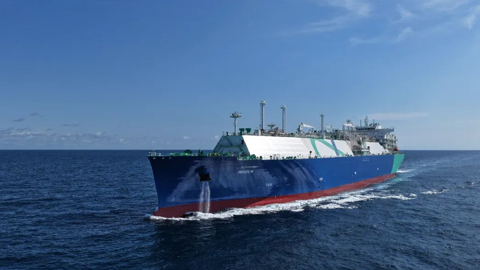
Recently, the COSCO Shipping Gemini, a vessel classed by CCS, was bunkered with 300 tons of green methanol in Hong Kong via a ship-to-ship (STS) mode, while simultaneously completing container loading and unloading operations.
China Classification Society facilitates the smooth delivery of the "Chongqing Emergency 012", the largest self-propelled crane ship in the upper reaches of the Yangtze River
On March 5, the world's first methanol dual-fuel powered roll-on/roll-off ship, the "CM HONG KONG" successfully completed its first green methanol bunkering operation in Hong Kong.
Recently, China Classification Society (CCS) was invited by the Australian Maritime Safety Authority (AMSA) to attend a technical workshop for port state inspectors. During the meeting, CCS shared and exchanged specialized technical achievements on the technical characteristics of new energy vessels, safety risk management, operational management, and key points of on-site inspections, providing professional support for the safety supervision and risk prevention system construction of new energy vessels. The meeting was held in two sessions, with port state inspectors from the four major regions of Australia participating.
Mr. Pan Zhongbing brings 32 years of distinguished professional expertise in ship survey and classification society operations, with profound technical acumen spanning ship and marine equipment survey, statutory compliance, quality management, flag state affairs, and maritime emergency response.
On January 26, the"Yuan He Kou", a 7,000-car LNG dual-fuel vehicle carrier, was named, delivered, and put into operation in Nansha, Guangzhou, with full technical support for plan approval , survey, and technical assistance provided by China Classification Society (CCS).
With the advancement of the temperature control goals under the Paris Agreement, the International Maritime Organization (IMO) has formulated a phased emission reduction roadmap, targeting a 20% to 30% reduction in international shipping greenhouse gas emissions by 2030 compared to 2008 levels, a 70% to 80% reduction by 2040, and the achievement of net-zero emissions around 2050.
On September 27, 2025, "Shandong Xinsheng," New-build vessel in China equipped with an Onboard Carbon Capture System (OCCS), was successfully named and delivered.
With the escalation of international shipping emission reduction requirements, Onboard Carbon Capture Systems (OCCS) have emerged as innovative equipment enabling deep decarbonization for traditional fuel-powered vessels.
Carbon Capture, Utilization, and Storage (CCUS) refers to the process of separating CO? from industrial processes, energy utilization, or the atmosphere and achieving its emission reduction and/or obtaining side effects through engineering means.
At its 81st session in 2024, the Marine Environment Protection Committee (MEPC) of the International Maritime Organization (IMO) formally proposed the draft "IMO Net-zero Framework," which was approved at MEPC 83 in April 2025.
On December 22nd, the " NEW EXPLORER"—a methanol dual-fuel intelligent very large crude carrier (VLCC) built by Dalian Shipbuilding of China State Shipbuilding Corporation (CSSC) for China Merchants Shipping—was delivered in Dalian, China. This milestone marks the world's first methanol dual-fuel VLCC to officially enter commercial service.
Recently, the naming and delivery ceremony for 174,000 m3 LNG carriers with membrane-type cargo tanks "Mihazem" and "Dongshani" for the Qatar Energy project was held in Hudong-Zhonghua Shipbuilding (Group) Co., Ltd.
Recently, China Classification Society (CCS) awarded Weichai Heavy Machinery Co., Ltd. (referred to as "Weichai Heavy Machinery") the Digital Application Accreditation Certificate for Diesel Engine Product Inspection.
As the technological revolution and industrial transformation accelerate, the transition toward digitalization and intelligence is an inevitable trend in shipping development, gradually becoming a powerful engine to boost the new quality productivity of the shipping industry.
Against the backdrop of the global shipping industry accelerating towards net-zero emissions, the application of sustainable fuels in ships has become a key pathway for shipping to achieve emission reduction targets.