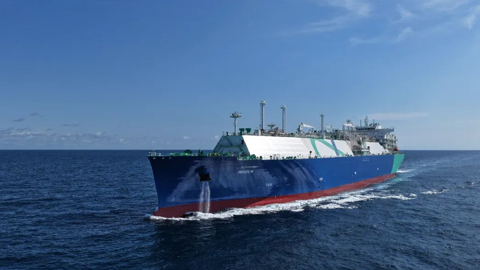
On September 27, 2025, "Shandong Xinsheng," New-build vessel in China equipped with an Onboard Carbon Capture System (OCCS), was successfully named and delivered.
By Wang Xinglong, CCS Jiangsu Branch

On September 27, 2025, "Shandong Xinsheng," New-build vessel in China equipped with an Onboard Carbon Capture System (OCCS), was successfully named and delivered. China Classification Society (CCS) issued the Classification Certificate and awarded the OCCS class notation to the vessel.
Built by Jiangsu New Hantong Ship Heavy Industry Co., Ltd. for Shandong Ocean Group, the vessel is a fourth-generation Kamsarmax bulk carrier. It is equipped with an OCCS covering the full technological process of "Absorption—Desorption—Compression—Liquefaction—Storage—Transshipment." Designed by the No. 711 Research Institute of China State Shipbuilding Corporation (CSSC), the system has been approved and surveyed by CCS. As a disruptive carbon reduction technology, OCCS makes it possible to achieve significant carbon emission reductions while using mature, low-cost traditional fossil fuels.

Carbon Capture, Utilization, and Storage (CCUS) refers to the process of separating CO2 from industrial processes, energy utilization, or the atmosphere to achieve permanent emission reduction. It mainly includes the capture, transportation, utilization, and storage of CO2. Onboard Carbon Capture System (OCCS) is the application of this technology on ships. It separates and captures CO2 from a ship's exhaust gas or fuel, which is then transported to a destination for resource utilization or injected into the seabed/formation for storage, preventing it from entering the atmosphere. As a disruptive technology, OCCS provides a viable pathway for the shipping industry's green and low-carbon development by enabling substantial emission reductions with traditional fuels.
Based on traditional energy power systems, onboard carbon capture technology generally utilizes the Chemical Absorption Method to capture carbon from exhaust gas. Its principle relies on temperature changes in the absorbent liquid to absorb and release CO2, thereby separating it from the exhaust. The process mainly includes four stages: CO2 capture, separation, compression/liquefaction, and storage/unloading. First, CO2 is captured from the ship's exhaust gas entering the absorption tower. It is then separated in the desorption tower, followed by compression, liquefaction, and purification. The purified and liquefied CO2 is then transferred to storage containers. The captured and stored liquid CO2 can be directly transshipped to a CO2 carrier at the port or unloaded at a specialized port. It can be supplied to processing plants as a raw material for chemicals such as alkali and alcohol, used for geological or biological purposes, or made into dry ice for seabed storage in designated sea areas.
In the application of onboard carbon capture technology, the following points are particularly noteworthy.
Carbon-containing flue gas |
Decarbonized flue gas |
Dryer |
Standard tank container |
Scrubbing water |
Gaseous CO? |
Subcooler |
Compressor |
Separation tower |
Absorption tower |
Heat exchanger |
CO?-rich absorbent (Rich solution) |
CO?-lean absorbent (Lean solution) |
Re-heater |
Liquid CO? |
Liquid CO? |
Transferred to CO? transport ship |
Soda/Alcohol production, etc. |
Storage at designated offshore locations |
Cooling water |
CO? Capture |
CO? Separation |
CO? Liquefaction & Storage |
CO? Utilization & Storage |

OCCS Principle Diagram
1.Installation on board
The main equipment of an OCCS typically includes exhaust gas bypass valves, CO2 fans, heat exchangers, absorption units, separation units, compression units, refrigeration units, liquefaction units, and storage units.
During installation on board, attention must be paid to the impact on structural strength and ship stability. Notably, the design of the intake and exhaust piping must prevent excessive back pressure on the ship's engine in the event of an accidental failure of the carbon capture system.
2、Layout Scheme
Tailored to different ship types and their operational characteristics, and comprehensively considering the required capture capacity of the OCCS, the required volume of the CO2 storage tank is calculated, and flexible layout schemes are adopted. At the same time, special attention should be paid to the risk of CO2 leakage.
3. Energy Consumption Optimization
Considering the relatively high operational energy consumption of OCCS, there is an urgent need to breakthrough high-efficiency and low-energy consumption CO2 capture and storage technologies to effectively reduce system energy usage. Simultaneously, the ship's power station capacity must have sufficient redundancy, and the system must be capable of emergency disconnection during overload conditions.
4. Technical Challenges
The technical challenge of OCCS lies in achieving stable, efficient, and low-energy operation on ocean-going vessels characterized by limited space and complex operating conditions.
The OCCS equipped on the "Shandong Xinsheng" has overcome core challenges in absorption technology and parameter control technology. While maintaining high standards of 99% CO2 liquefaction rate and 99.9% liquid CO2 purity, it effectively reduces system energy consumption and CO2 dissipation, and enhances storage tank capacity, making it well-adapted to the complex operating environment of ocean-going ships.
CCS attaches great importance to the formulation, development, and application of survey standards for OCCS. During the project advancement, multiple CCS units conducted numerous technical seminars. System experts were assigned to shipyards for technical promotion and experience exchange, providing rectification plans for technical optimization.
During the ship construction process, CCS site surveyors focused on controlling the operational performance of the carbon capture system and safety risk management nodes, providing comprehensive, high-quality services and technical support, which have been highly recognized by all parties.
Note: If you need to reprint, please indicate the source of the information.