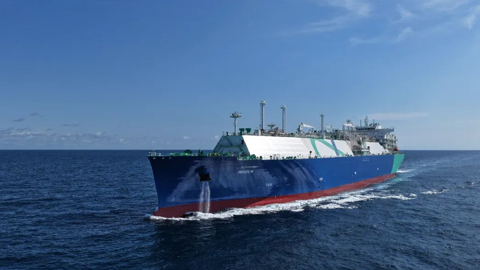
On July 16, the "BYD ZHENGZHOU", a 7,000-ceu (car equivalent unit) dual-fuel Pure Car and Truck Carrier (PCTC) built by Guangzhou Shipyard International Co.
On July 22, the "Seminar on moving full steam ahead to step up comprehensive capability as International Shipping Center" (a.k.a 2025 CCS Council Meeting), hosted by China Classification Society (CCS), was held in Shanghai.
On 3 July 2025, in the margins of the 91st Council meeting of the International Association of Classification Societies (IACS), China Classification Society (CCS) and IACS jointly held a high-level meeting with stakeholders at CCS Headquarters.
Recently, China's first domestically-built 16,136 TEU methanol dual-fuel container ship "COSCO SHIPPING YANGPU" and the nation's inaugural hydrogen-electric tug "QING DIAN TUO 1" were successfully delivered, injecting green vitality into the industry.
Recent reports by People’s Daily and CCTV on the delivery of China’s first 100,000-ton smart salmon farming vessel 'Su Hai No. 1' have sparked heated public discussion—heralding an era of 'affordable sashimi'!
On June 24,2025, the new 85,000-ton multi-purpose vessel "CSPC JADE", which was approved by China Classification Society for drawing and construction inspection, was successfully named and delivered.
Recently, China Classification Society (CCS) Dubai Branch and Highlander held an intelligent ship technology and new product promotion meeting in Dubai.
On June 10, 2025, China Classification Society (CCS) and Everllence held a certificate-awarding ceremony for four-stroke methanol dual-fuel engines in Copenhagen, Denmark.
On July 4, 2025, the 7G80MEC-LGIM-EGRTC methanol dual-fuel low-speed marine diesel engine inspected by China Classification Society (CCS) was successfully delivered by Dalian Marine Diesel Co., Ltd. of China State Shipbuilding Corporation (CSSC).
In recent years, multiple fire accidents on Roll-on/Roll-off (Ro-Ro) vessels caused by thermal runaway of electric vehicle (EV) batteries have severely impacted waterborne traffic safety, posing significant risks to the vessels, personnel, and vehicles being transported.
At present, greenhouse gas emissions reduction has become the focus of concern and discussion in the international community, and the shipping industry, as an important logistics and transportation mode supporting global trade, is also facing enormous pressure for transformation and upgrading.
In recent years, with the acceleration of international shipping emissions reduction, the application of wind-assisted propulsion technology onboard ships has also attracted increasing attention from the industry.
In the context of the global shipping industry’s accelerated transition towards green and low-carbon operations, China Classification Society (CCS) has continuously increased its research and development efforts in rules and standards for wind-assisted ship propulsion technology.
With increasing global attention on greenhouse gas emissions from the shipping industry, wind-assisted propulsion technology, as a clean and renewable energy solution, has gradually garnered significant interest from the maritime sector.
At China Classification Society (CCS), there is a technical team that cracks the code of green transformation by taking wind as a medium when the shipping industry is seeking a breakthrough in the wave of environmental protection;
Sails were once the primary driving force for humans to conquer the ocean. Today, in the urgent context of carbon reduction in the global shipping industry, this ancient technology is being revitalized in the new form as a “wind-assisted propulsion” system (WAPS).
Recently, China Classification Society (CCS) and Maritime Transport Dept. Ministry of Interior , State of Kuwait formally signed the Statutory Survey Authorization Agreement.