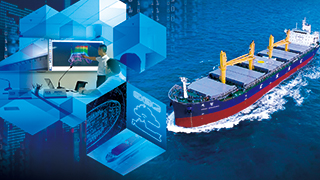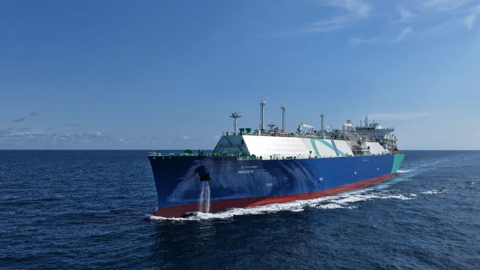
On January 26, the"Yuan He Kou", a 7,000-car LNG dual-fuel vehicle carrier, was named, delivered, and put into operation in Nansha, Guangzhou, with full technical support for plan approval , survey, and technical assistance provided by China Classification Society (CCS).
With the advancement of the temperature control goals under the Paris Agreement, the International Maritime Organization (IMO) has formulated a phased emission reduction roadmap, targeting a 20% to 30% reduction in international shipping greenhouse gas emissions by 2030 compared to 2008 levels, a 70% to 80% reduction by 2040, and the achievement of net-zero emissions around 2050.
On September 27, 2025, "Shandong Xinsheng," New-build vessel in China equipped with an Onboard Carbon Capture System (OCCS), was successfully named and delivered.
With the escalation of international shipping emission reduction requirements, Onboard Carbon Capture Systems (OCCS) have emerged as innovative equipment enabling deep decarbonization for traditional fuel-powered vessels.
Carbon Capture, Utilization, and Storage (CCUS) refers to the process of separating CO2 from industrial processes, energy utilization, or the atmosphere and achieving its emission reduction and/or obtaining side effects through engineering means.
At its 81st session in 2024, the Marine Environment Protection Committee (MEPC) of the International Maritime Organization (IMO) formally proposed the draft "IMO Net-zero Framework," which was approved at MEPC 83 in April 2025.