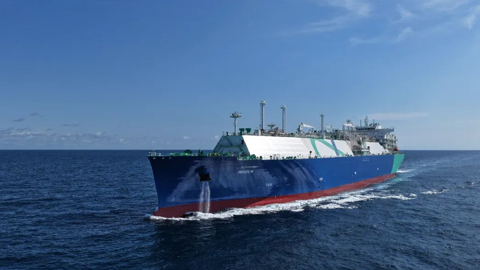
June 2026 saw the global fleet of wind-propelled cargo ships officially surpass the 100-vessel milestone, with over five million deadweight tonnes (DWT) of cargo capacity, following the latest round of wind propulsion system installations on large commercial vessels.
Interview with Mr. Gavin Allwright,
Secretary General of the International Windship Association (IWSA)
By Longyu Xue, China Ship Survey
June
2026 saw the global fleet of wind-propelled cargo ships officially surpass the
100-vessel milestone, with over five million deadweight tonnes (DWT) of cargo
capacity, following the latest round of wind propulsion system installations on
large commercial vessels. What was once widely regarded as a niche or historical
form of marine propulsion is now rapidly emerging as one of the practical
decarbonisation solutions gaining momentum across the shipping industry.
Commenting
on the milestone, Mr. Gavin Allwright, Secretary General of the International
Windship Association (IWSA), said that reaching the 100-vessel mark represents
an important market marker for wind propulsion technology. As manufacturing
scales up and installation experience grows, particularly if fuel prices remain
elevated, the return-on-investment timeframes are expected to continue
shortening, further strengthening the appeal of wind propulsion for shipowners.
However, he also emphasised that “we can go further and faster”, calling on the
industry to focus on scaling deployment towards the goal of 1,000 vessels and
beyond.
In
a recent exclusive interview with China
Ship Survey magazine, Mr. Gavin Allwright shared his insights on key
industry topics, including the growth drivers of wind propulsion, the choice
between retrofit and newbuild pathways, technology evolution trends,
operational optimisation potential, and the role of wind in global shipping
decarbonisation and regulatory compliance. During the interview, Allwright
elaborated on the tangible value of wind propulsion in reducing fuel costs,
meeting environmental regulations and enhancing energy security. He analysed
the reasons behind the early lead taken by tankers and bulk carriers, as well as
the challenges facing segments such as container ships. He also expressed
strong expectations for the key role of China’s maritime community in the
global wind propulsion value chain and the prospects for deeper cooperation
going forward.

Mr. Gavin Allwright,
Secretary General of the International Windship Association (IWSA)
Q: The number of large
commercial vessels equipped with wind propulsion systems has increased nearly
fivefold over the past four years. What do you see as the key drivers for sustaining
such rapid growth momentum going forward?
A: As with all innovation and equipment
dissemination, there are some bottom-line drivers that help maintain rapid
growth. These include high prices for the alternative (i.e. fossil fuels and
incoming alternative fuels), the continued lowering of costs and price of the
product, through economies of scale, a steady supply chain and increased
capacity for installation. The appetite for shipowners to lower operational
costs, through lowering fuel costs and investment into equipment with
relatively quick ROIs is also vital. To maintain that investment appetite, we
need a generally predictable geopolitical situation and a clear regulatory
pathway forward, both of which are rather challenged currently.
From
a wind propulsion specific perspective, then to maintain this growth we also
need standard approaches to evaluation and validation, which are being
developed. The aggregation and anonymization of that performance data also help
the market to assess the technology segment and the systems on offer, and this
will be increasingly possible in the next year or so. There are of course many
other smaller drivers, but the final significant one is that yards increasingly
add wind propulsion systems to their makers lists and offer these to customers
as standard equipment rather than bespoke.
Q: Wind propulsion
technology is applied both as retrofits to existing ships and increasingly
integrated into newbuild designs. Over the next few years, what respective
roles will the retrofit and newbuilding markets play in the industry’s growth?
What are the main factors shipowners weigh when choosing between these two
paths?
A: As with all things ‘shipping’ it is rather
challenging to generalize across many sectors, the factors considered by say a
cruise or container line operator will be significantly different than those
considered by tanker sector or for offshore vessels. Having said that, there
are some general points that all shipowners will consider – cost, ease of
installation, performance and regulatory compliance.
From
a cost perspective, it will usually be lower cost to do any reinforcement work
and foundations, cabling etc. in a newbuild project, and we see some that
coming through in making ships ‘wind-ready’, especially at the lower level of
reinforcement/design and evaluation. Ease of installation follows a similar
pathway, when it is easier to install when a vessel is being built, however
this is marginal when foundations have already been set (as in higher level wind-ready)
or the shipowner has chosen a more modular approach, where all ships in the
fleet have foundations and the units themselves are then move between ships.
There is a still pervasive myth that a wind installation is a relatively
permanent fixed asset, like an engine system and this is a misconception,
indeed units can be easily removed and reinstalled in a matter of hours or a
few days for more complex systems.
When
it comes to performance, then a ship designed and integrated with wind will
likely be the one where you will get the best performance out of the wind
system and the ship. If it is to be an optimized wind-assist delivering 20-30%
propulsive power from wind or a primary wind vessel, delivering 50-80%, then
the newbuild pathway will be the natural one to follow.
Regarding
regulatory compliance, then retrofit is a very important pathway, as many
existing ships have few energy pathways to compliance with say emissions
regulation. If you are able to add wind propulsion (10-20%) to energy
efficiency gains (c.20%) and operational optimization, (c.20%) then you can
really start to make a dent in ETS charges but also lower the energy intensity
of the vessel in FEUM or the IMO GFI calculations. Fuel EU is already the case
that with 15% wind propulsion installed, then a 5% reward will be available,
ensuring that ship would effectively be compliant (using banking or pooling)
until the mid-2030s, avoiding US$1200 per ton of fuel charges.
Q: Tankers and bulk
carriers currently account for the largest number of vessels equipped with wind
propulsion systems. What are the main reasons these vessel segments are leading
adoption? Conversely, what factors are limiting the wider uptake of wind
propulsion across other vessel types?
A: Bulkers and tankers both have a fair
amount of deck space for deck installed wind systems, so they have been a
relatively lower hanging fruit for installation. These vessels also burn a lot
of fuel and are relatively slow which means that performance of wind propulsion
can deliver quite well for these, especially on longer cross ocean routes.
There is also the innovation staple that when a sector delivers 3-5 reference
vessels using a particular technology that this enables easier assessment in
the market and this ‘critical mass’ has been reached through first mover
shipowners and technology providers, thus generating some significant momentum
there.
Most
other segments are approaching this ‘tipping point’ but it takes time to
cascade through those segments, especially if they are dominated by smaller
operators, such as general cargo or to a degree the RoRo cargo segment.
The
container ship segment is a challenging one, as deck space is at a premium and
when fuel prices are held artificially low (real price of fossil fuel is 3-4x
current levels if all externalities are fully costed), then the trade off of
wind propulsion and cargo space is rather challenging. Technically and
operationally however, systems can certainly be incorporated at build on these
ships, and there are a number of design projects underway. With off-deck
systems such as kites or some other options, the retrofit of wind systems could
certainly be considered too
Q: In recent years, the
industry has developed a range of wind propulsion solutions. How do you see
wind propulsion technology evolving in the future? What room for optimisation
remains in terms of efficiency, cost, and vessel compatibility, etc. for the technologies?
A: Unfortunately, I don’t have a crystal
ball, however we can see some parallels with other sectors, and we can get some
indications from the pipeline of technologies coming through.
Firstly,
the development of a number of different wind technologies is a really positive
element for the technology segment, this keeps internal competition strong and
that feeds into upgrades, optimization and the lowering of costs and ultimately
prices over the mid- to long-term. It does of course bring some challenges on
system selection, but each technology has particular strong benefits and there
is an element of ‘horses for courses’, where two or three systems will likely
match the criteria for each vessel, and then as the market matures further,
decisions will continue to be made on performance, validation etc. but also
upon availability, servicing agreements and on the colour you like (joke!)
We
are still in the first decade of deployment and only the first few years of
early scaling, so if we look at the offshore wind sector, we have seen truly
incredible scaling in power, material and engineering developments and cost
reduction in this field, wind propulsion is likely to follow that path.
From
a pipeline perspective, there are a lot of technology innovations and new
design ideas coming through and we are likely to continue to see more protypes
and ships coming through in the next few years. That healthy pipeline indicates
that engineers and designers see additional scope for optimizing and leaning
into the potential of wind.
With
existing systems, these have been proven and as they scale, costs will fall
precipitately and production capacity is already in the high hundreds, so
supply should not be a problem.
Q: In real-world vessel
operations, what are the key factors affecting wind propulsion performance?
What measures can be adopted to maximize its effectiveness?
A: I am not an engineer, nor an operator of
wind installed vessels, however the main factors that affect wind propulsion
performance follow the answers to these questions;
Have
you selected the appropriate system for your vessel and sighted those units
well? Is your vessel on a good route for wind and/or can you use wind-routing
software that can substantially improve the performance? Is the wind system
well integrated into your energy management system, therefore optimizing
engines when the ship receives fluctuating amounts of wind power? Are your crew
and management well familiarized with the operation and maintenance of the
systems?
If
a ship owner is answering these key questions and works with the technology
provider to ensure that these are answered positively, then you will be getting
the best out of your wind systems.
Q: The shipping industry
is currently exploring diverse decarbonization pathways, including clean
alternative fuels and electrification. In comparison, what unique advantages
does wind propulsion offer? What role will it play in the future global
maritime energy transition?
A: The unique sales points for using wind are
multiple, and I will focus firstly on this as an energy source in the list
below
Wind
energy is….
·
Zero
emissions – all emissions, not only carbon (including climate impacting H2,
N2, CH4, BC, VOCs, URN etc.)
·
Zero
cost – free energy forever
·
Zero
infrastructure
·
Zero
onboard storage
·
Zero
pollution or fire risk
·
Globally
available and abundant
·
Supply
open to all – global commons
Wind
propulsion technologies are…
·
The
only energy pathway technology that will pay for itself
·
Adding
range and a degree of energy security to your fleet
·
Relatively
low carbon footprint and embedded carbon/energy
·
Low
maintenance & Easy to understand
·
Mostly
automated and require no additional crew
·
Low
risk of fire, non-toxic, relatively low safety concerns
What
role will it play in the future global maritime energy transition? This is a
really a matter of choice – could wind propulsion become the primary energy
pathway for future shipping – yes, it could. We have the technology,
understanding and materials to build wind into all vessels, retrofitting all
ships to a 20% level in the next 5-10 years is very doable. Then all new ships
are either designed as optimized wind-assist [30-50%] or primary wind [60-80%]
and these are supplemented by a basket of electric, liquid or gaseous fuels.
However, we could also take that paradigm further, how about utilizing all of
the wind power that we fail to harness, and capture that and convert that
onboard as a fuel, then we start to move into a ‘perpetual motion’ situation,
or could we call that a truly ‘autonomous energy ship’
The
latter part is of course blue sky thinking, however there are projects working
on these concepts and we have a number of large yachts and research vessels
generating in this way.
However,
if we stick to more conservative assessments, then it is completely possible to
reduce dramatically the amount of low carbon commoditized fuel that we need to
reach a net-zero goal in the 2050s. Indeed, I would suggest that we can’t get
there without substantial roll out of wind, coupled with a strong emphasis on
energy efficiency and voyage optimization. If we only need to supply 20-40% of
the current fuel demand by the 2040’s, then that is a very different nut to
crack.
Q: As a key industry
association connecting wind propulsion technology developers, research
institutions, and the wider shipping community, IWSA has undertaken extensive
work in technology promotion, standard-setting, industry exchange, and policy
engagement. What areas will IWSA prioritize in the coming years?
A: All of those areas need continued efforts,
especially in standard setting and policy advocacy areas. Wind propulsion is
the oldest (cleanest) way of moving ships, but it has been out of the
mainstream for a long time. This means that there is a segment of the industry
and external stakeholders that are still reticent, resistant or simply
unengaged, so it is vital to keep moving on all fronts, but especially
integrating wind propulsion into the technical, operation and compliance
frameworks. The integration of wind as an ‘energy source’ rather than an
‘energy efficiency’ is particularly important at a policy level as there is a
very strong tendency to see unaffordable alternative fuels as the target for
subsidies or special treatment, leaving wind energy unsupported and actively
biased against.
We
also want to have standard approaches that treat wind fairly adopted in the
legal, insurance and contractual areas, thus leveling the playing field and
enabling shipowners to fully unlock the potential of wind.
Over
the next two years we will be involved with the development of IMO interim
guidelines for wind propulsion safety and training, and these will help to
ensure some of that level playing field continues to develop.
Q: Standing at the
milestone of 100 vessels and looking toward a future with 1,000 or more
vessels, as Secretary General of IWSA, what are your expectations and
recommendations for stakeholders across the global industry chain?
A: It is an interesting feeling, we rarely
stop to take stock – we have waited for a decade to reach this buoy maker on
the wind propulsion channel and yet as we hit it, our members are already way
past that point and preparing the ships for the next hundred, signing the
contracts for the next and laying the foundations for the next wave.
My
expectations are that wind propulsion will go mainstream in the next couple of
years, be the go-to propulsion energy option well into the 2030s and will
become a no-brainer option for all shipowners shortly afterward. The UK
government assessed that wind propulsion would be installed on 40-45% of the
world fleet by 2050, I think that is conservative and could be far higher.
I
am not sure that I am in the position to recommend any course of action in a
global industry with all of the expertise there. I can, however, ask a few
questions:
Que
1. Is there another energy option that has all of the benefits listed above,
with technology that is available off the shelf now and that will deliver an
element of energy security and make your fleet both compliant and save money?
If there is, then I would implement that alongside wind on every vessel in my
fleet.
Que
2. Can we wait to act on future proofing the global fleet until we have a
certain regulatory framework, geopolitical stability or a lull in the environmental
drivers? If not, then we need to act on the low hanging fruit right now, wind,
energy efficiency, crew training, digitalisation and voyage optimization all
pay for themselves.
Que
3. It is time to choose ----- which colour would you like?
Q:How do you view the
potential for wind-propelled vessel applications in the Chinese market? In
which areas can IWSA and China’s maritime community further strengthen
exchanges and cooperation?
A:China is a central shipbuilding and unit production
powerhouse, and this sector holds a huge growth potential. However, it is also
true that China is a key owning/flagging nation and therefore mandating wind
ready for newbuilds for the domestic fleet would be a significant step, as
would increasingly adding wind propulsion systems (both domestic and foreign
producers) to standard equipment lists in Chinese yards.
In
the realm of strengthening exchanges and cooperation, sharing the experiences
of Chinese shipyards in installations and the research that is underway in
maritime research centres will be a great boost to the sector as a whole. We
currently have a call for abstracts open for our next Wind Propulsion
conference to be held in Singapore in April 2027, with a strong emphasis on
Asia-based research and experience, this will be hosted by Royal Institution of
Naval Architects (RINA) and IWSA. We also hope to organize more events and
opportunities to exchange experiences in China in the coming years and we are
open to discuss possibilities to push that agenda further. Finally, a great way
to help foster further cooperation is to join our association as a member. We
have a small group of Chinese companies as members or registered supporters,
and you will be most welcome if you would like to join the other 200+ members
to help shape the future of wind propulsion together.
Note: If you need to reprint, please indicate the source of the information.