CCS
and Industry Partners Jointly Release New Energy-Powered Vessel Types for
Domestic Navigation 2026
On July 11, 2026, China Classification
Society (CCS) released New Energy-Powered
Vessel Types for Domestic Navigation 2026 at the China Maritime Day Forum.
The publication analyzes the development pathways of fuel technologies for
inland and coastal shipping and, in collaboration with industry partners,
presents technical solutions for eight representative new energy vessel types tailored
for key waterways. It provides a reference for decision-making, demonstrating
and spearheading the green and intelligent transformation and upgrading of the
shipping sector.
Background
Driven jointly by the International Maritime
Organization (IMO) carbon neutrality target and China’s “dual-carbon” goals,
the shipping industry is accelerating its transition toward green and
low-carbon development.
At present and for a period to come, clean
energy for shipping in China will see a landscape where multiple technology
routes including batteries, methanol, and liquefied natural gas (LNG) develop in
parallel. Leveraging China’s industrial and technological strengths, CCS
believes that battery and methanol can serve as important marine fuel technology
pathways for China’s inland and coastal shipping sectors.
Based on the principle of “seaworthiness, port
compatibility, and cargo suitability”, and taking into account environmental and
economic factors, CCS, together with relevant industry partners, has released
technical solutions for eight representative new energy-powered vessel types
for key waterways, offering options for the shipping market.
Released Vessel Types

600-Passenger
Methanol-Powered Yangtze River Luxury Cruise Ship
Designer:
Chongqing Changhang Ship Design and Research Institute
Principal
dimensions (m): 149.99 × 23.2 × 4.7
Primary
Operating Waterway: Yangtze River main line
This is the first Yangtze River luxury
passenger cruise vessel equipped with a methanol fuel propulsion system. It
overcomes key technical challenges associated with methanol bunkering, tank storage,
compartment ventilation, and venting control. While ensuring ship safety, the
design maximizes passenger-use areas and balances navigational safety with
cruise operation quality. While ensuring vessel safety, the design maximizes
the passenger use area, balancing navigation safety with cruise operation
quality. The vessel adopts a methanol direct-injection single-fuel main engine,
achieving a methanol substitution rate of approximately 90% and reducing fuel
costs by nearly 30%. It integrates multiple core technologies, such as
integrated cruise comfort configuration, novel vessel type development,
emission reduction and intelligent equipment R&D, comprehensively enhancing
habitability, environmental indicators and intelligent capabilities. It is expected
to be awarded the following class notations: Green Ship-3, EEDI-3, COMF (NOISE-3),
COMF (VIB-3), and i-Ship (E).
18,000 DWT
Methanol-Electric Hybrid Bulk Carrier

Designer: Shanghai Bestway Marine
Technology Development Co., Ltd and others
Principal
dimensions (m): 139.80 × 25.60 × 8.0
Primary
Operating Waterway: Yangtze River main line
This vessel type combines the technical
advantages of green low-carbon, intelligent equipment, and economical
operation. It is equipped with a methanol single-fuel plus methanol-electric
hybrid propulsion system, optimizing power response characteristics and
improving adaptability to complex operating conditions on the Yangtze River, with
an estimated CO? emission reduction of over 8%. Through refined design based on
goal-based standards, combined with hull form optimization and the application
of high-efficiency propulsion units, the steel weight of the hull is reduced by
3.24% compared to the baseline vessel, significantly improving overall
navigation performance. The vessel is equipped with intelligent navigation and
berthing/unberthing assistance systems, effectively enhancing safety during
navigation and mooring operations in complex waterways and adverse weather
conditions. Compared with vessels of the same size powered entirely by diesel,
fuel operating costs are expected to drop by more than 25%. It is expected to
be awarded class notations including Green Ship-2.
5,000 DWT LNG-Powered
Pinglu Canal Demonstration Vessel

Designer:
Guangxi CSSC Beibu Gulf Shipbuilding and Marine Engineering Design Co., Ltd.
Principal
dimensions (m): 90.0 × 15.8 × 6.1
Primary
Operating Waterway: Pinglu Canal
Designed primarily for operation on the Pinglu Canal
main line, this vessel type follows five design principles: safety, energy
efficiency, green, intelligence, and home-like comfort.
The selection of main
parameters such as principal dimensions and deadweight tonnage fully considers
the requirements for seaworthiness, port compatibility and cargo suitability
for vessels navigating the Pinglu Canal. The vessel adopts an LNG single-fuel power
system and is designed and built to meet the application requirements for an
intelligent integrated platform, intelligent machinery, autonomous navigation,
automatic berthing/unberthing and remote control, achieving an integrated
demonstration of intelligent shipping with coordinated ship-port-lock
operations along the Pinglu Canal. It is expected to be awarded green and
intelligent class notations including Green Ship-3 and i-Ship (N, E).
73 m Electric Multi-Purpose Vessel with Smart Wheelhouse

Designer:
Shandong Xinneng Ship Technology Co., Ltd.
Principal
dimensions (m): 73 × 13.76 × 5.1
Primary
Operating Waterway: Beijing-Hangzhou Grand Canal
This vessel type is adapted to the navigation
conditions and mainline cargo transport demands of the Beijing-Hangzhou Grand
Canal. It adopts an all-electric propulsion solution, achieving zero carbon
emissions and low-noise operation during voyages, with outstanding environmental
performance. The ship is equipped with a modular containerized battery system
and features a 15-minute rapid battery swap process, ensuring efficient and
convenient swapping, along with comprehensive intelligent configurations. By
replacing oil with electricity, the operating costs are reduced by over 40%
compared to conventional fuel-powered ships. With design deadweight of about
3,000 t and a range of up to 200 km, it serves as a benchmark vessel type for
the green transformation and upgrading of inland shipping on the Grand Canal.
The ship’s power equipment and smart wheelhouse have obtained CCS product
certification. It is expected to be awarded class notations including BRC and Green
Ship-3.
1,000 TEU Methanol Dual-Fuel River-Sea Container Ship

Designer:
Shanghai Bestway Marine Engineering Research & Design Co., Ltd.
Principal
dimensions (m): 139.9 × 24.0 × 13.0
Primary
Operating Waterway: Designated river-sea direct routes
This is currently the largest river-sea container
ship by deadweight built or under construction in China. It is equipped with a
methanol dual-fuel power system, integrating energy-saving devices such as a
high-efficiency propeller, propeller boss cap fins and a shaft generator.
Through coordinated optimization of the hull lines and general arrangement, it
achieves excellent overall energy efficiency and green performance. The vessel
is fitted with a four-cylinder oscillating cylinder steering gear and a bow thruster,
significantly enhancing navigational stability in adverse weather and complex
waterways, as well as maneuverability during berthing and unberthing. The cargo
holds are equipped with container cell guides, fully adapting to the efficient
loading and unloading demands of smart ports. The vessel is qualified to carry
dangerous goods of classes 1 to 9 except class 7. About 100 reefer plugs are
provided on the deck, greatly increasing cargo stowage flexibility. Its overall
performance indicators and technical features are at the leading level among
similar vessel types in China. It is expected to be awarded class notations including
Methanol Fuel and AUT-1 (Automation-1).
20 m Electric City Tourist Ship

Designer:
Shanghai Maritime University
Principal
Dimensions (m): 20.6 × 5.2 × 1.3
Primary
Operating Waterway: Urban rivers
This is a city sightseeing vessel integrating
waterborne transport and tourism functions, suitable for Shanghai’s Suzhou
Creek and similar urban inland waterways. With a passenger capacity of 37 and
nighttime operation capability, it is equipped with a pure battery electric
propulsion system, achieving zero emissions and zero pollution throughout its
operation. The exterior design incorporates tech-aesthetic concepts, featuring
a panoramic retractable glass canopy structure that can flexibly switch between
enclosed cruising and open-air sightseeing modes, balancing all-weather
navigability with scenic view requirements. Compared with traditional
diesel-powered vessels, its operating costs are significantly lower, and it
offers technical advantages such as low noise, no vibration and smooth
operation. The vessel has already obtained CCS class notations Tourist Ship and
Battery (Power) and is a demonstrative vessel leading green and smart water
tourism in China.
160 TEU Methanol-Powered Container Ship

Designer:
Yihang New Energy Technology (Jiangsu) Co., Ltd.
Principal
Dimensions (m): 88.0 × 13.72 × 5.9
Primary
Operating Waterway: Coastal waters and Xiaoqing River
This is a standardized new energy vessel adapted for
the Xiaoqing River and coastal waters, integrating green, advanced, intelligent
and economic features. It relies on a single methanol generator set plus a
lithium battery pack with an AC intelligent network, featuring strong system
safety and significantly reduced crew skill requirements. Coupled with a
self-developed EMS system, it overcomes the soft response characteristics of
methanol generator sets, realizing high-efficiency economic operation while
eliminating dependence on shore power. Equipped with an intelligent visual
perception system, it pushes intelligence toward unmanned operation. Using
green methanol fuel, the vessel can achieve near-zero carbon emissions over its
full life cycle and reduces operating costs by 30%. It is expected to be awarded
the Green Ship class notation.
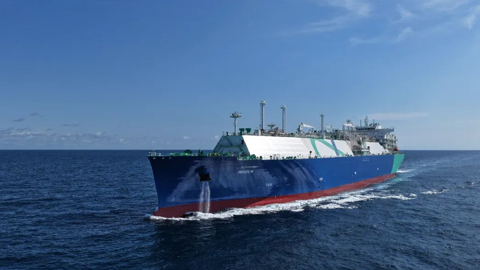
8,600 m3 LNG Bunkering/Transport Ship

Designer:
China Ship Design & Research Center Co., Ltd (CSDC)
Principal
dimensions (m): 119.3 × 19.8 × 11.0
Primary
operating waterway: Coastal waters
This vessel type is an upgrade based on the
original 8,500 m3 LNG bunkering vessel, precisely designed to meet the growing
demand of the LNG fuel supply chain. It is equipped with a power system
primarily consisting of four L20DF LNG dual-fuel generators, two pulling-type
azimuth electric thrusters and a bow thruster, ensuring high maneuverability
and operational flexibility while offering excellent redundancy and propulsion
efficiency. The vessel adopts an independent type B cargo tank, combined with a
proprietary patented support system, resulting in a low boil-off rate and
convenient construction. Additionally, two cryogenic reliquefaction units are
installed to effectively reduce evaporation losses, further enhancing the
vessel’s economic benefits. It is expected to be awarded the green ecological class
notations including G-EP and G-ECO.
Next, CCS will work with the industry to
build a spectrum of typical new energy-powered vessel types for domestic waterways,
facilitate the optimization and adjustment of the domestic water transport
structure, and comprehensively boost the high-quality development of the
shipping industry.
For further needs and comments, please
contact the CCS Technical Support to Survey Department at sd@ccs.org.cn.
Note: If you need to reprint, please indicate the source of the information.