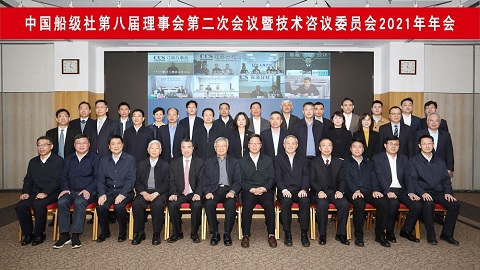
On 3 July 2025, in the margins of the 91st Council meeting of the International Association of Classification Societies (IACS), China Classification Society (CCS) and IACS jointly held a high-level meeting with stakeholders at CCS Headquarters.
On 3 July 2025, in the margins of the 91st Council meeting of the International Association of Classification Societies (IACS), China Classification Society (CCS) and IACS jointly held a high-level meeting with stakeholders at CCS Headquarters. Mr. CAI Yanxian, Senior Vice President of CCS presided over the meeting.
The high-level meeting, themed "Navigating Decarbonization and Digitalization in the Maritime Industry", featured in-depth discussions on key issues. Over 80 representatives from International Maritime Organization (IMO), Active Shipbuilding Experts’ Federation (ASEF), Waterborne Transport Bureau of China's Ministry of Transport, Maritime Safety Administration of China, Singapore Maritime and Port Authority (MPA), Hong Kong Marine Department, China Association of the National Shipbuilding Industry (CANSI), China Shipowners' Association, as well as shipowners, shipyards, designers, IACS and its member classification societies attended the event.

During the keynote speech session, Mr. Sveinung Oftedal, Chair of IMO Intersessional Working Group on Reduction of GHG Emissions from Ships, Mr. Cheah Aun Aun, Director (Shipping) / Director of Marine of MPA and Mr. Wang Dongbo, Deputy Secretary-General of CANSI delivered keynote speeches from different perspectives including IMO's mid-term GHG emissions reduction measures, flag State regulation and practices of China's shipping industry.

Mr. Oftedal focused on the main decisions made at MEPC 83 and the work plan in 2025 including strengthening Carbon Intensity Indicators (CII), advancing the Net-zero Framework and implementing GHG fuel intensity (GFI).

Mr. Cheah stressed the importance of a "people-centered" regulatory framework design in the green and digital transformation of the shipping industry, and shared Singapore's practices in methanol and ammonia fuel bunkering, seafarer training, collaboration with stakeholders including classification societies, and the application of technologies like drones by MPA in various situations.

Mr. Wang elaborated three solutions China provided for the green and digital transformation of the shipping industry, including shaping a green/digital shipbuilding industry, building more green/smart ships, and supplying more green fuels/energy for ships. He also expressed the willingness of CANSI to strengthen close cooperation with shipowners, classification societies and stakeholders in the future.

Mr. Robert Ashdown, IACS Secretary General, moderated the panel discussion. To facilitate the discussion, Mr. Roberto Cazzulo, IACS Council Chair outlined the vision and mission of IACS and classification societies, their contributions to the IMO, current priorities, and future challenges and opportunities. Subsequently, he engaged in lively discussions with keynote speakers on key issues including ship decarbonization safety, digital transformation in shipping, autonomous vessel development, human-centered design, and regulatory and rules improvements.

During the open discussion on IACS CSR Rule Change Proposal moderated by Mr. Roberto Cazzulo, following IACS Hull Panel Chair Mr. CHO Hyungmin’s presentation, ASEF representatives Mr. Wu Jiameng, Mr. Kuma Yasumitsu, Mr. Yang Jaeho and Mr. Li Wenhe as well as meeting participants exchange views on industry concerns, correlation between CSR revision and safety, impact of CSR revision on ship design and construction, and implications of alternative fuel use on CSR development.
In his concluding remarks, Mr. Cai Yanxian emphasized that while the twin transition in our industry was complex, it was not unattainable. He stressed that through concerted efforts and close collaboration among stakeholders, our maritime community can build a future that is truly resilient, zero-carbon and digitally empowered. He confirmed that CCS, alongside other IACS Members, remained fully committed to working hand in hand with regulators and industry partners, and would stay aligned with technological advancements and strive to make a collective contribution to a safer, cleaner, and more efficient shipping sector.
Note: If you need to reprint, please indicate the source of the information.