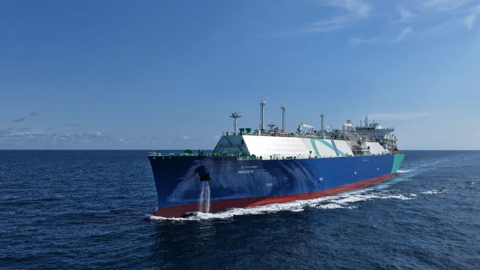
“André M”, the 25000 m3 Ammonia Dual-Fuel Gas Carrier, was delivered to Tianjin Southwest Maritime Limited on 6th November 2026. Built by CSSC Huangpu Wenchong Shipbuilding Company Limited, designed by Shanghai Merchant Ship Design and Research Institute (SDARI), and plan-approved and surveyed by China Classification Society (CCS) Guangzhou Branch, the vessel is the first Type A-tank gas carrier classed by CCS — and China’s first ammonia dual-fuel gas carrier, the third of its kind worldwide.
“André M”, the 25000 m3 Ammonia Dual-Fuel Gas Carrier, was delivered to Tianjin Southwest Maritime Limited on 6th November 2026. Built by CSSC Huangpu Wenchong Shipbuilding Company Limited, designed by Shanghai Merchant Ship Design and Research Institute (SDARI), and plan-approved and surveyed by China Classification Society (CCS) Guangzhou Branch, the vessel is the first Type A-tank gas carrier classed by CCS — and China’s first ammonia dual-fuel gas carrier, the third of its kind worldwide.
The vessel is a milestone for using ammonia as a marine fuel. It represents a key technical breakthrough in the zero-carbon transition of global shipping, and offers a practical reference for the IMO as it develops international rules for the use of ammonia cargo as fuel.

The vessel is 159.9 meters in the overall length, which is pre-fitted with ammonia bunkering connection and has the CCS class notation ABDR 1 (Ammonia Bunkering Design Ready). It is powered by a WinGD 6X52DF-A-1.0 ammonia-fueled main engine incorporating the latest-generation high-pressure ammonia direct injection technology. In compliance with MSC.1/Circ.1702, Interim Guidelines for Use of Ammonia Cargo as Fuel, the vessel can use the liquefied ammonia cargo, which it carries, directly as fuel. Also the vessel can switch between fuel oil and ammonia modes, and has the class notation Ammonia Fuel. When the main engine operates in ammonia mode, COx emissions are significantly reduced, achieving near-zero carbon emissions. The vessel is also equipped with HPSCR system, which can significantly reduce NOx emission.
When the project kicked off in early 2024, CCS Guangzhou Branch established a dedicated project team, providing end-to-end services including plan approval, product certification and on-site surveys. For two and a half years, CCS has been delivering targeted services and responding rapidly to technical issues. The project team worked closely with designer and shipyard to keep project on schedule. In the meanwhile, safety and quality of the project were strictly guaranteed.
In the beginning of the project, there was no regulation concerning the use of ammonia cargo as fuel for liquefied gas carriers. With technical support from the CCS Wuhan Rules and Regulations Institute and led by the Guangzhou Plan Approval Center, the project team held multiple rounds of technical discussions with shipowner, shipyard, and relevant authorities in the Marshall Islands and Singapore, finally developing a set of specialized technical standards accepted by all parties. To match the shipyard’s project schedule for Type A cargo tank, CCS conducted plan approval in advance, sending senior plan approval surveyors to SDARI to verify the finite element analysis and temperature field calculations during the design process of Type A cargo tank. This enabled the design drawings to be reviewed and approved when the design was being finalized. This improvement sharply shortens the plan approval cycle, greatly smoothing the process of design, plan approval and construction.
Before delivery, CCS project team offered technical solutions on key issues on ammonia-fuel mode, and maintained close communication with the administration until its technical proposals won final approval, thus securing a smooth delivery of the vessel in ammonia-fuel mode.

This successful delivery fully demonstrates the feasibility of ammonia as a fuel for liquefied gas carriers. CCS will continue to research on ammonia-fueled ships, summarize the technical achievements and service experience of this project, focus on the new challenges of green shipping, and support the low-carbon transition of the industry with reliable technical expertise for more new-energy vessel projects.
Note: If you need to reprint, please indicate the source of the information.